Evaporative cooling: the honest maths for Pakistani factories
Split AC or cooling pads? The honest answer depends on what your air is doing, not on what the salesman is selling. The maths we run on site before anyone spends money.
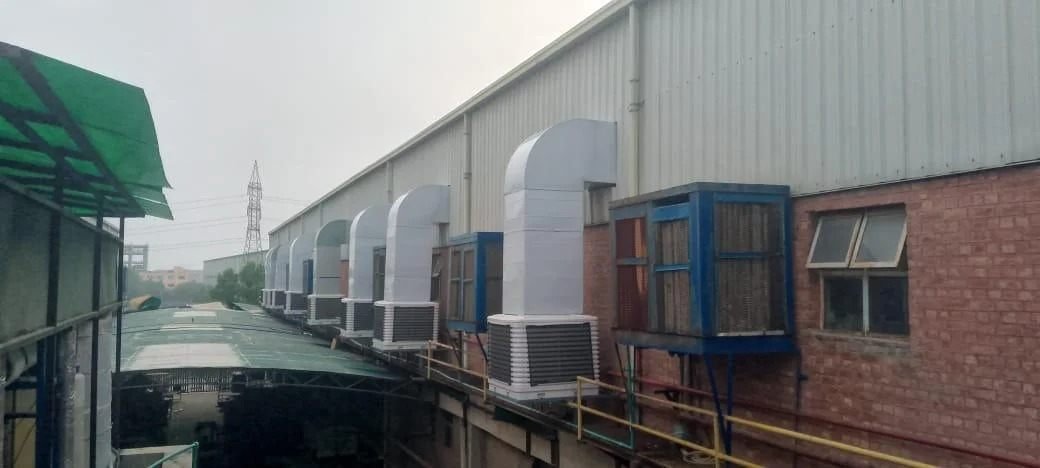
Every summer we get the same phone call. A factory floor is unbearable by noon, the owner has priced a wall of split ACs, and someone in the meeting has mentioned "those cooling pads" as the cheap option. Both sides of that conversation are usually half right. Evaporative cooling is not poor man's air conditioning; it is a different machine that happens to be brilliant in dry heat and nearly useless in humidity. Here is the maths we run on site before anyone spends money.
What it can and can't do
An evaporative cooler does not compress refrigerant. It evaporates water into the air stream, which pushes the air temperature down toward the wet-bulb limit, the point where the air is too humid to absorb more moisture. That limit is everything. In the dry heat of a Punjab May or June, when the air is hot but thirsty, a well sized unit can drop the supply air by 8 to 12 degrees. In August, when the monsoon raises humidity, the same unit manages 2 or 3 degrees and the floor starts to feel damp. Same machine, opposite results.
The numbers that matter
- Power. A cooler moving enough air for a mid-size industrial hall draws a fraction of the equivalent AC tonnage. No compressor. On a plant that runs cooling ten hours a day, that gap is a serious line on the electricity bill.
- Water. The trade you make for low power is consumption: litres per hour, every running hour. In areas with hard water, that trade also buys you scaling on the pads.
- Air changes. These units work by flooding the space with fresh air and pushing the hot air out. If the building has nowhere for air to leave, you have bought a very expensive humidifier.
An evaporative cooler without a planned exhaust path is a humidifier with a fan attached.
When we tell clients no
There are processes where the honest answer is "don't": textile spinning, where humidity swings snap yarn; pharmaceutical and food handling with written moisture specs; electronics assembly; any room holding servers or switchgear. And any sealed hall where we cannot create a clean path from air inlet to air exhaust. AC recirculates and dehumidifies, which is what those processes need. Saying so early has saved more than one client from a purchase they would have regretted within a season.
The details that decide it
Where it does fit, the difference between a satisfied client and a complaint is rarely the unit itself. It is the details around it.
- Pad quality and maintenance. Thin pads clog in one dusty season. Factory air is dusty by definition, so filtration and a replacement schedule are not optional extras.
- Water treatment. Hard water scales pads within months. A small treatment step protects the whole system.
- Ducting and placement. Cooling the whole hall evenly is usually the wrong goal. Spot-cooling the packing table, the heat press, the occupied workstations, with the duct aimed where people and machines actually are, does more with a smaller unit.
- Exhaust area. Openable louvres or extraction points sized to the supply air. We check this before anything else on a survey.
Where it fits the net-zero picture
Most of our industrial clients carry a net-zero or energy-reduction commitment they cannot yet quantify, and our industrial cooling project was delivered for exactly that reason. Evaporative cooling is one of the few upgrades where the saving is almost arithmetic: every hour of AC load you replace is kWh you stop buying, and the peak cooling load sits exactly in the hours your solar array is strongest. That makes it one of the cheapest first steps in an energy plan, and one of the easiest to report honestly.
What it costs
Less than you expect, on a timeline you control. A bay-level unit with sensible ducting is a days job. A full plant, with air path redesign, pad banks and water treatment, is a scoped project of weeks. The survey decides which one you actually need, which is why we do the survey first and quote second.
Unsure which side of the humidity line your process sits on? WhatsApp us with your hall size and process, and we'll tell you whether evaporative makes sense. Sometimes the honest answer is "it doesn't," and that answer is free.